Nepal has wide range of green forest throughout the nation. It has lots of wild national parks to perverse the forest itself and the animals that live inside it as well. The illegal poaching and hunting has made so many of the animals extinct in Nepal as well. So these national park helps to prevent those sort of illegal activities.
Amongst all Royal Chitwan National Park (RCNP)is the oldest national park of Nepal. It was established in 1973 and was granted the status of a World Heritage Site in 1984. It nearly covers an area of 932 km². The RCNP is located at the foot of the Himalayas in the Terai region. It xtends up to Chitwan, Makawanpur, and Bara districts of Narayani Zone of the mid-development region. There RCNP is home to at least 43 species of mammals, 450 species of birds, and 45 species of amphibians and reptiles in Nepal. A few of these animals include sambars, chitals, rhesus monkeys, and langurs. Amongst these animals the most precious and rich in flora and fauna are single-horned Indian Rhinoceros (Rhinoceros unicornis) and the Bengal tiger. The climate of this area is tropical.
Lots of kings in the past used it as their big game of hunting until 1951 A.D. The park now is the main attraction for tourists who are nature lover. The tourist from different countries come here for rafting, safari, trekking, canoeing, elephant riding, etc. There are many hotels, lodges, and resorts outside the nation park for the comfort of the tourists
Royal Chitwan National Park
Saturday, June 23, 2007
Dakshinkali Temple
Monday, June 18, 2007
The word Dakshinkali is made up of Dakshin and Kali. Dakshin means south and Kali is derived from one of the Hindu goddess Kali. So it basically means the goddess Kali of the south. So the Dakshinkali temple is situated south-west part of the Kathmandu which is just 45 minutes drive from Kathmandu. The sanctuary and its surroundings are dedicated to goddess Kali, the deity who claims at least twice (Tuesday and Saturday) a week a good portion of fresh animal blood. So lots of devotees gather there in a huge mass especially on Tuesday and Saturday where they usually sacrifice cocks and he goats.
On the way, the sight of the gorge is impressive and it is worthwhile to walk down and across the old suspension bridge, throwing a glance down into the very narrow and deep chasm. In the midway near the village of Pharping, lies the the pleasant spot called Sheka Narayan. There is a pond filled with crystal clear water and lots of gold fish type fishes swimming around. After some minutes of drive from Pharping you will finally reach to the destination of the Dakshinkali where you now have to move downhill as the goddess is situated at the bottom of the hill. The view is just spectacular with all the green vegetation around and the weather is just too awesome around there. Not only the Hindu devotees but we can find lots of other groups of people going there to enjoy their picnic as well. Since the place is quite far away from the valley and there is less crowd and less noise and other pollutions, people prefer to go there to take a break and have a nice picnic with all their friends and families.
So this place is important with entertainment prospect as well as holy place. People do believe that if we pray to the goddess and offer sacrifices our enemies will demise and we will be victorious in our way, and lots of other people do make their wish to the goddess and they believe the goddess will make those wishes come true if you wish from heart and offer sacrifice to the goddess. Well that’s about the place and the rituals of Dakshinkali. I suggest that every tourist should at least once visit this holy place to experience the peaceful surrounding over that place.
Aurora – Northern and Southern Light
Monday, June 11, 2007
Long time ago my professor Nirmal P. Shrestha had written a post about Aurora. I find it so much interesting. I haven't gone through the details in net as of yet but I think by reading what he wrote everyone will get the idea of it pretty much. Here is what he had said and written 10 years back.
Aurora may be described as the luminous display in the sky which lasts for times of few minutes and on occasions even form sunset to sunrise. When it occurs in the northern hemisphere it is known as aurora borealis. Although no two displays are ever exactly alike, a few appear to follow general pattern. The display commonly is in the form of a pale yellow-green color which may be steady or suddenly start moving and fluttering like drapery struck by wind. Many of the forms show enhanced color effects with yellow, green, crimson-red, and violet.
The lower borders of most of the auroras are at about 105 km, and the upper border of the diffuse type are several hundred kilometers above the earth. Regarding the geographic distribution, the region of greatest frequency of auroral occurrence has an average altitude of 67 degrees for the northern hemisphere and perhaps 72 degrees in the southern hemisphere.
A relatively detailed study of the motion of aurora has recently been made possible by the use of “all-sky cameras” (first invented by a German scientist Dr. Willy Stoffregen).
The horizontal thickness of relatively quite aororal arcs as measured at Churchill is 8km. The horizontal length of arc may exceed 2000 km on occasion.
The earth is surrounded by a magnetic field. During storms on the surface of the sun a stream of protons and electrons moves out from the sun at speeds of approximately 1600 to 2400 km/sec. On reaching the earth’s upper atmosphere they collide with the atoms and molecules of oxygen and nitrogen of the atmosphere. Oxygen atoms exited by electrons give out a greenish yellow light while oxygen molecules produce a crimson red glow. Ionized nitrogen and Nitrous oxide molecules also contribute to this phenomenon.
Radio Aurora
An abnormal ionization is associated with aurora (first reported by sir E.V. Appleton and his colleagues). Since 1947 a great variety of techniques have been used to investigate this phenomenon. The term radio aurora is used to the ionization concerned.
Measurements of the height of the aororal ionization carried out by radio techniques have shown that most echoes originate in the height range 100-120 km. Motions of auroral ionization have been deduced from Doppler shift. The velocities involved in the motions are usually in the range 100-600 m/s.
Many attempts have been made to establish a close correspondence between radio aurora, but the results are far from conclusive.
Manakamana Temple
Saturday, June 9, 2007
 Ever thought of having a die hard wish that you need to get fulfilled? Well if you do have faith in Hindu gods, there are many ways where you can pray and wish for your wishes to come true. One of the Devis (goddesses) is Manakamana, where “mana” came from the word “mann” which means heart and “kamana” means wish. So it is believed that if you wish it from your heart the goddess Manakamana fulfills those wishes. I have been there thrice in my lifetime but with my family, mom and dad, who had made their wishes. I don’t know what they wished for and if it did come or true but I believe it must have as we have been their thrice.
Since 17th century the Manakamana temple has been widely venerated, as of the obvious reason of believing that Manakamana Devi (goddess) fulfills all wishes. It is located just 102 kilometers from the capital, Kathmandu, en route to Pokhara and Chitwan and banks of Trishuli River which is famous for white water rafting.
My first visit to Manakamana was when I was a kid. I can hardly remember all the details but I do remember my brother-in-law did carry me in his shoulders for couple of minutes on the road. So that again means I really was a kid back then. We had hiked 6 hours up the hills to reach to the final destination of Manakamana Temple. Though for the normal people it takes just about 3-4 hours to reach there. We might have gone a little slower enjoying the beautiful views and scenario of the beautiful hills seen from there; that I still remember. It was quite fun back then.
Since the popularity of the wishing goddess became overwhelming that now we have better ways and faster ways to get to Manakamana. They made it easier with installing cable car to the hill. This is the first and only cable car service running in Nepal. So instead of the four-hour arduous trek, the shrine is now accessible in just 10 minutes in the cable car which is using the world-renowned Doppelmayr Technology of Austria. So with the abundant time in hand we can easily visit the shrine and make our wish. Yet the number of visitors are increasing day by day. There will be a long queue not only on the way to cable car but to the holy shrine as well, but it is worth it as now we can visit and return in a single day without having our time lost in the hard uphill hike. Yet there are lots of groups who still trek uphill as they love to hike and enjoy the beautiful scenes of the hills and mountains of our beautiful country Nepal.
Uses And Abuses Of Science
Sunday, June 3, 2007
 I just was reading an old magazine and I found this interesting topic about “uses and abuses of science.” I read the whole article and I am now trying to share it to my blog about what I read in that article.
It started with one beautiful quote made by Shakespeare, “Nothing is good or bad but thinking makes it so.”
Science is neither good nor bad. It is neutral. It does good to the man if it is so employed. It does harm to humanity if it is used otherwise. The majority are the uses of science. It has given us numerous things of everyday life. It has changed the world rapidly. Bertrand has Ressell rightly remarked, “Sconce has changed the face of the earth and the world has changed more during the last 100 years than during the 4,000 years previous to that.”
Science has given us remarkable things. Radio is one of the earliest invention and part of science. We hear distant speakers sitting in our home. We enjoy the songs of famous musicians on it and important news is broadcast everyday. Television sets present us the pictures of distant place with the same news broadcast, music, and lots of other information everyday. Telephone is another gift of science. It facilitates a talk between two persons living at a great distance. And now we got computers which basically combine all of the latest technologies and helps from a kid to a big business tycoon.
We have rapid means of transport these days. Journeys of months can be completed within days or even hours today. There are the motorcar, the trains, and the airplanes. To travel 50 or 60 miles in an hour is an ordinary thing. An airplane covers hundreds of miles per hour. Science has really shortened time and distance. The work that took months of years can be completed in hour or few days now. Printing press has enabled quick publication of books. The production of mills is thousands of times quicker than that of the village weavers. Again long distances are covered within short periods. Diseases have also been lessened by the scientist and doctors. Medicines and injections cure many incurable disease of the body. Science has mechanized agricultural wok. It has revolutionized the fields of production. We can find a whole lot of benefits of science and a simple post isn’t enough to state all its benefits.
But there are many disadvantages o
 f science as well. It has also given the deadly weapons in the hands of the man. The guns and canons are the things of the past. This is the age of Atom and Hydrogen bombs and Rockets. It is feared that the human order may come to an end in the war of Atom bombs and Hydrogen bombs. Machines themselves have done much harm. They have thrown an army of laborers out of employment. They are held responsible for the creation of overcrowded cities with unhealthy surroundings. They have created class problems by creating wealth in the hand of a people. Science has made man too materialistic. People have forgotten their soul. They fail to recognize the Almighty, the creator of the universe.
The advocates of science speak of comforts and advantages provided by it but the destructions and disasters caused by it is also to be considered. We are to realize that man himself is responsible for its uses and abuses; its proper use will bless him, its misuse will destroy him.
Kathmandu: Most Happening Place - New Road
Wednesday, May 30, 2007
If you ask me where is the heart of Kathmandu, I would definitely say either Basantapur or Newroad. Well both places are nearby each other. From kids to teenagers to the old people, New Road is the most happening place in town. I mean you name it and you got it there. From beautiful big restaurants where you can sit back and relax to small ones with very cheap price menus, from big shopping malls like Bishal Bazar, Pashupati Plaza, R.B. Complex to the shop unnamed shops for buying the things your needs, with a nice park in the middle of the New Road called Bhugol Park (Bhugol means the globe or the earth itself) which is currently under construction, from clothing, jewelry to electronics, you name it you get it at New Road.
New Road came from the old name Juddha Sadak which was named after one of the Rana Prime Mister Juddha Samsher Rana. Then it was named as Naya Sadak in Nepali or Nhugu Satak in Nepal Bhasa language which means New Road in English. Well since lots of tourists, mainly hippies, used to be here in the 80s the place became famous with the English name as New Road. Literally New Road has four lane street which is in the center of Kathmandu.
Though the place is usually crowded by people I never tend to get enough of the places. When I am out for a walk with my friends. I would be most probably going to that place once or twice a day. It really is one of the happening place in town as lots of people with different interests are gathered in the same place at most of the times of the day.
Kathmandu - New Baneswhor
Wednesday, May 23, 2007
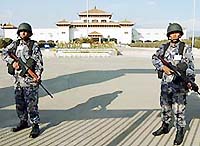 This post has been provided by my dearest friend Jenisha. I thought of gathering someone else’s thoughts than mine about my city Kathmandu and I asked her to comment her views of her hometown. She has just beautifully tried to describe the town where she was born and tried to explain the landmarks and important and happening places in Baneswor.
“The battered buildings, the crowded markets, the dusty streets, and the unreliable weather!” Some find these traits of Kathmandu very hard to deal wit but for some like myself these are the reasons why Kathmandu valley is so special and unique. There is no city in the world that I can fit in so well as I do in Kathmandu, and there is nowhere else I can feel at home as I do in New Baneswor.
Baneswor is located at the heart of Kathmandu. It is so wide that for the convenience of the people the whole area is divided in to two; the northern area called Old Baneswor and the southern area called New Baneswor. New Baneswor is the new, very happening place in Kathmandu. The main landmark of the New Baneswor is the Birendra International Conventional Center where programs of high importance concerning education, environment, entertainment, felicitations, etc are held. New Baneswor houses many good colleges in the valley as Himalayan White House College, Ace Management Institute, etc. The place is always buzzing with crowds as it is where two very reputed departmental stores, Navadurga and Baneswor Departmental Store, are located. With leading banks like Standard Chartered and Everest Bank and exquisite hotels and restaurants like Everest, Alinas, Nanglos, etc for all the food lovers and a very reliable nursing home namely Everest Nursing Home.
It won’t be very incorrect to say that New Baneswor is probably the most developed part of Kathmandu. The roads and public vehicles to all the part of the city have made New Baneswor even more accessible. It is the one stop for all the needs of everyone in all walks of life. My Baneswor is the best part of Kathmandu.


